

Extended reality is no longer a futuristic concept, but it is taking place today, and it is assisting businesses to grow, compete, and work smarter. Additionally, extended reality for business could be the creation of memorable customer experiences, a better training process, or increased cooperation, but the extended reality (also known as XR) is providing companies with tools, something that is much more than technology.
The extended reality market is now being developed rapidly. Further, businesses are embracing XR to work more efficiently and reduce costs. At the same time, XR allows businesses to build stronger, more meaningful connections with both customers and employees. Meanwhile, advances in hardware, software, and connectivity have made XR solutions far more affordable and flexible. As a result, now is the perfect time for businesses of any size to explore the possibilities XR has to offer.
What Is Extended Reality (XR) and How Does It Work?
The technology that integrates both the virtual and real worlds is referred to as extended reality (XR). It includes:
- Augmented reality (AR), where digital content is placed over the real world.
- Virtual reality (VR) creates fully immersive, computer-generated environments.
- Mixed reality (MR) allows digital objects to interact with the real world.
XR solutions use hardware like headsets and smart devices. They also rely on software that tracks movement and space, allowing digital and physical elements to interact in immersive experiences.
Why Smart Companies Are Betting on XR Today?
Increasingly, many organizations are experimenting with XR as it provides actual, quantifiable value.
- Higher Engagement and Better Learning: The conventional way of training, such as slide training or videotraining, can be monotonous and unmemorable. XR involves interactive learning. To illustrate, in VR, workers can train on complex activities before performing the same real-life – something that enhances confidence and minimizes errors.
- Safer, Faster Training: Real-life practice could be dangerous or expensive in industries such as construction or healthcare. So, XR allows employees to be trained safely in a realistic mode without risking their lives and wasting resources.
- Better Decision-Making and Visualization: It becomes easier to comprehend complicated concepts when individuals are able to visualize information or designs in 3D. Moreover, building plans can be taken through walks by the architects. Engineers are able to analyze obscure components of a product. Flat screens cannot give the same opportunities to decision-makers to explore concepts.
- Enhanced Customer Experience: Individuals do not forget superb experiences. XR assists brands in rising to the top, be it with virtual try-ons to increase online purchases or creating immersive experiences that will leave customers happy and willing to do business with the brand again.
- Competitive Advantage: Early adopters of XR usually experience quicker onboarding, higher customer satisfaction rates, streamlined operations, and brand image. Additionaly, the time taken to wait may leave the competitors enjoying the fruits of the fruits.
10 High-Impact XR Applications in Business
ER is not restricted to a single field of industry – businesses in various sectors are discovering useful, valuable applications of it:
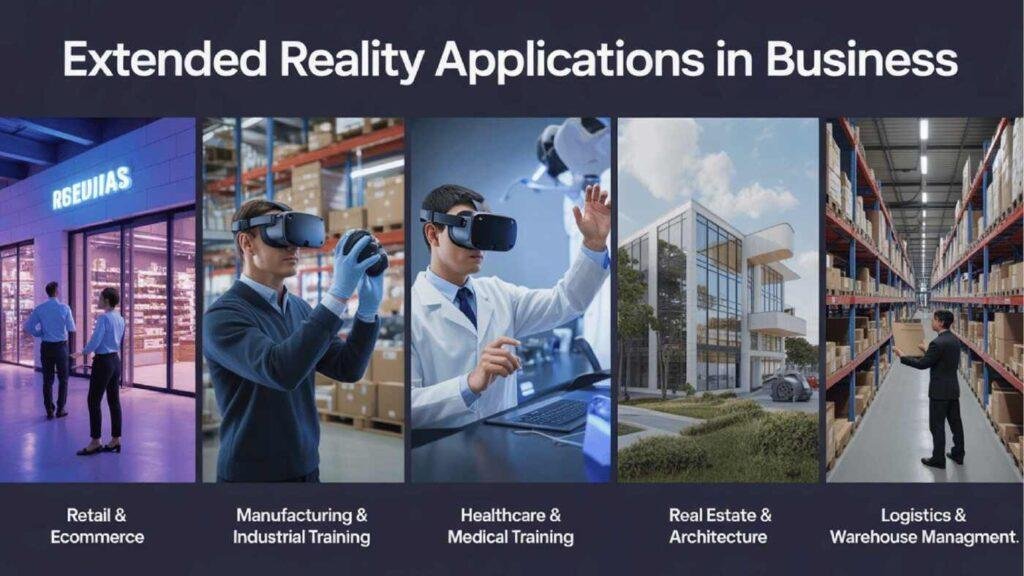
- Retail & Ecommerce: AR allows customers to view products in their natural environment and virtually try products — decreasing returns and enhancing confidence.
- Manufacturing and Industrial Training: VR allows employees to train on the management of equipment and safety protocols without interfering with the production process and causing accidents.
- Healthcare and Medical Training: Medical students and professionals are able to study anatomy in 3D and practice procedures in a low-risk and controlled environment.
- Real Estate and Architecture: Customers are able to take virtual tours of the properties, and designers develop spaces prior to the construction commencing.
- Field Service and Remote Assistance: Technologists can work with instructions on the AR glasses and, at the same time, the specialists can work remotely, which will save both time and costs.
- Education and Corporate Training: Students and employees can go through the immersive learning environments that simplify otherwise difficult subjects.
- Product Development and Prototyping: Virtual spaces allow teams to work together on 3D design as teams can iterate faster, and fewer prototypes can be made.
- Marketing and Brand Engagement: Immersive campaigns and XR brand experiences create buzz and have more intensive impressions as compared to conventional adverts.
- Workplace Collaboration: Remote teams can meet in virtual environments, which are more conversational and less video conferencing.
- Logistics and Warehouse Management: AR may also direct employees in an inventory activity, draw attention to objects, and streamline day-to-day operations.
XR Tools, Platforms, and Extended Reality Services You Should Know
You must have the right tools and partners to create successful extended reality solutions.
- Hardware Tools
These tools are the extended reality:
- VR headsets
- AR smart glasses
- Mobile gadgets with spatial tracking.
Hand tracking, spatial audio, and sharp images, commonly available enterprise-level XR hardware, are some of the features that give digital content a sense of reality.
2. Software Platforms
Hardware is no less important than software. The typical inputs in XR development are:
- 3D engines such as Unity or Unreal.
- AR toolkits, such as ARKit and ARCore.
- Cloud solutions for content delivery and analytics.
Other companies develop XR experiences within their company, whereas other companies collaborate with dedicated agencies to design, develop, and launch XR projects.
Step-by-Step Roadmap to Launch Your First XR Project
There is no need to make the beginning of XR overwhelming. A clear plan helps:
- Determine High-Value Use Cases: Choose a business issue where XR can contribute to a change.
- Set Clear KPIs: Understand the definition of success – accelerated training? Higher engagement? Better sales?
- Choose Tools and Partners: Determine in-house vs. outsourcing to an XR agency.
- Develop, Test, and Iterate: Begin with a pilot, receive user feedback, and refine and scale.
- Plan for Change Management: Organize your teams, educate users, and harmonize workflows to maximize adoption.
Common Challenges of Extended Reality in Business
- Technical complexity: Starting small before growing.
- Economical issues: Start with the tools at hand and track ROI.
- User resistance: Demonstrate value early and do hands-on training.
Future of Extended Reality in Business
The future of extended reality in business is bright and embellished with intriguing trends:
- AI + XR: Integration of artificial intelligence and XR will make experiences more intelligent and adaptive, such as real-time translation and intelligent simulations.
- Workplace Collaboration: Remote work will be more interactive and productive by using virtual offices and a shared workspace in XR.
- Metaverse-Style Experiences: With the increased sophistication of the digital world, businesses will establish branded virtual worlds where customers shop, communicate, and connect in a completely different manner.
Over the coming years, firms adopting the XR approach will experience stronger unification of online and in-real-life operations – and gain an actual advantage over their competitors who deliberate.
Extended reality is already providing real business value nowadays. Extended Reality business offers tools and solutions that are available today Whether you want to improve training, enhance customer experiences, or streamline operations, XR can help. Hence, an opportune moment would be when your competitors have yet to do it.