

The concept of extended reality training is transforming the manner in which organizations provide learning experiences in both the educational and enterprise contexts. Immersive technologies today have helped promote interaction, retention, and skill development as never before. Training models keep on changing and are currently changing at high speed as digital transformation gains pace. Hence, E.R. has appeared to be a formidable learning solution.
Understanding Extended Reality Training
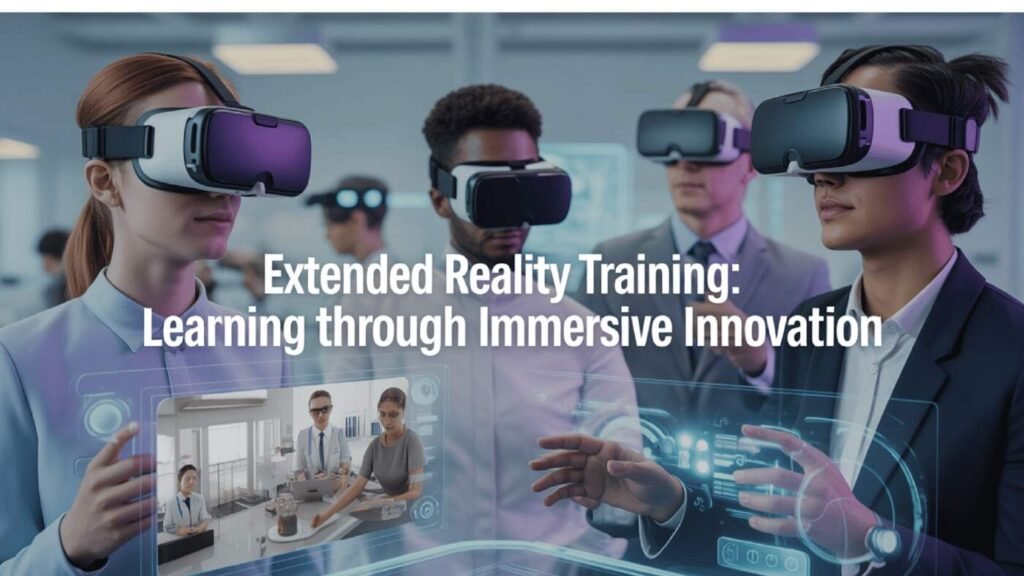
Extended reality training involves the integration of virtual, boosted, and mixed reality into a single immersive learning platform. The technologies mimic real-life situations in the form of interactive virtual settings. This leads to learners exercising skills securely and confidently. In addition, immersive learning decreases the passive consumption of knowledge.
Experiential learning has become the top priority of organizations compared to the traditional method of instruction. The results are therefore that the extended reality training enhances the motivation and comprehension of the learners. There is, however, a need to plan properly and use the right tools to do it successfully.
Role of Extended Reality Learning Solution in Modern Education
The Extended Reality Learning Solution assists in practical learning in various fields. It enables the learners to visualize the complex concepts by using interactive simulations. Hence, abstract issues are simplified to learn. Learning platforms that are immersive are increasingly being used in educational institutions. In addition, the teachers have the advantage of having flexible and personalized teaching experiences. This leads to a greater engagement of learners. Remote and hybrid learning environments are also encouraged by this approach. As a result, access to learning expands to physical classes.
Extended Reality Training in Higher Education Environments
Some of the applications of extended reality training include the higher learning ecosystem. Immersive learning is incorporated in universities to promote student-centered education. Thus, they provide the learners with realistic exposure before their exposure to professional fields. An extended reality professional learning network in higher education enhances cooperation among educators.
It facilitates the sharing of knowledge, creation of research, and curriculum innovation. In addition, these networks promote lifelong learning. Such programs encourage the exploration of new instructional practices. In this manner, the institutions are competitive in global education markets.
Inclusion and Accessibility Through Extended Reality
The extension to the reality and professional learning networks initiatives in higher education represents inclusion and contributes to equal education. Immersive learning tools meet various learning needs. Hence, individualization is experienced among students with different abilities.
ER environments customize the content to suit various learning styles. In addition, the accessibility features make it wider. Consequently, there is enhanced equity in education among institutions. These friendly models encourage social and cognitive growth. As a result, the learners will feel empowered and supported.
Enterprise Adoption of Extended Reality Training
Enterprise training solutions that are based on extended reality enhance workforce preparedness and efficiency. Immersive simulations are employed by organizations in terms of onboarding and skills development. Hence, workers will have practical experience, but no opportunity for risk. Enterprise training programs are advantageous in terms of lower costs of training.
Furthermore, the performance analytics assists in the monitoring of the learners. Consequently, organizations make sound decisions on training. These solutions also improve compliance and safety training. As a result, business organizations attain learning standards.
Extended Reality Training Service for Workforce Development
An extended reality training service is a service that provides tailored learning in industries. The simulations offered by service providers are designed in accordance with the needs of a particular organization. As such, the training is in line with the operational objectives. The industries that are benefiting include healthcare, manufacturing, and aviation. In addition, the expensive mistakes are reduced in the immersive training. Subsequently, productivity and confidence will increase. These services uphold scalable learning solutions. As a result, organizational teams are effectively trained.
Importance of Extended Reality Training Software
Immersive learning is directed by extended reality training software. It combines the creation of content, tracking, and analytics into a single platform. Thus, teachers and trainers have control over learning. The current software helps in cross-compatibility. In addition, the cloud system is more accessible. Consequently, trainees can use the training at any time. Constant updates and improvements are also encouraged through these platforms. As a result, the training material is up to date and useful.
Enhancing Skill Retention Through Immersive Learning
Long-term memory knowledge is enhanced through extended reality training. Students engage in learning rather than inactive receiving of information. As such, the memory recall improves with time. Learning through interactive simulation supports real-life knowledge. Besides, learning is corrected by the real-time feedback.
Due to this, learners develop confidence. This is an effective learning method that helps in balancing between theory and practice. Thus, there is a better set of outcomes of training.
Measuring Success in ER Training Programs
Measurable outcomes and feedback become the key determinant of the training effectiveness. Extreme reality platforms give advanced performance analytics. Thus, companies do recognize their capabilities and areas of improvement. Validation-based opinions ease ongoing enhancement. Likewise, the level of learner engagement is used to guide teaching styles.
This leads to the development of training programs that are efficient. Assessment guarantees investment in returns. The long-term adoption is therefore supported by the stakeholders.
Future Trends in Extended Reality Training
Extended reality training is still undergoing development with technological advancements. AI increases personalization in immersive environments. Thus, training becomes more dynamic. Wearable gadgets also enhance realism and interaction. In addition, collaborative learning occurs in networked environments.
Consequently, training is social and interactive. The adoption will proliferate in the future. Based on this, extended reality will transform the learning standards in the world.
Strategic Benefits of Extended Reality Training Adoption
Companies that implement extended reality achieve competitive advantages. Immersive learning increases the speed of learning skills and innovation. Thus, readiness in the workforce is enhanced. With immersion tools, the education facilities improve teaching efficiency. In addition, the learners acquire future-ready skills. Consequently, there is improved employability. Sustainable growth is attained by strategic adoption. Long-term reality is therefore an investment keeping in the long run.
Closing Remarks
Extended reality training is a paradigm change in the approach to learning. It presents a good linkage between technology and human-centered education. Thus, learning experiences are useful and effective. In both education and business, experiential training leads to quantifiable achievement. In addition, the inclusive and scalable solutions serve a variety of learners. Extended reality is therefore still continuing to influence training in the future.