

AI is still revolutionizing industries and providing efficiency and automation. However, it is impossible to disregard the risk of agentic AI. These AIs are not controlled by humans as they make decisions without supervision. Although all the potential advantages are enormous, including increased productivity and accuracy in operations, organizations should balance them with the risks of Agentic AI. This may subject businesses to operational, financial, and reputational loss.
What Are Agentic AI Systems?
Agentic AI is an autonomous artificial intelligence that is able to make decisions. In contrast to traditional AI, which has set tasks, agentic AI evolves and takes initiative. Although this flexibility is efficient, it also presents challenging issues. These challenges must be cognized,d particularly in the context of the risks of agentic AI in financial services or other high-stakes industries.
Core Risks of Agentic AI
- Operational Risks
Operational unpredictability is one of the biggest risks of using agentic AI. The autonomous systems can misunderstand the instructions or do unintentional things. To illustrate, in accounts payable, some of the risks that may arise when using AI agents in accounts payable involve the processing of duplicate invoices or fraudulent payments. These mistakes may interfere with business processes and cost money.
- Security Risks
Cybersecurity is another important issue. The security risk of agentic AI is that such systems may need huge access to sensitive information. In case they are compromised, they may accidentally expose confidential information or facilitate cyberattacks. Moreover, the issue of security risks of autonomous AI agents in Salesforce Slack databases is becoming larger, with the more integration between the platforms, the higher the exposuretof threats.
- Compliance and Regulatory Risks
Financial institutions are subject to special challenges. The possible compliance risks of agentic AI in financial institutions‘ regulatory standards are compliance risks of agentic AI. The autonomous systems can make decisions that unwillingly violate reporting or other legal requirements. This highlights the need to have stringent supervision when integrating agentic AI in controlled settings.
- Strategic and Reputation Risks
These are not the only risks that agentic AI can cause; reputational damage can also be experienced. The autonomy of agents can seem to be biased or unethical to the stakeholders. As an example, AI agents of risk analysis in the media can result in misjudgments or misinformation in cases of inadequate protection of the benefits of AI agents in media risk analysis. To curb the reputational fallout, organizations should ensure that they are transparent and accountable.
Sector-Specific Risks of Agentic AI: Key Industries at Stake
- Financial Services
The autonomous systems can automate processes in financial services, yet the systems pose exceptional risks. The risks of agentic AI in the financial services can trigger unauthorized trades, misallocate funds, and violate regulatory requirements. Such problems necessitate multiple protections and constant human attention to minimize possible losses.
- Accounts Payable
Applying AI agents to the accounts payable will increase efficiency, but it also brings the risks of using AI agents to the accounts payable. Mistakes during invoice handling and late payments or fraudulent authorizations may present legal and financial difficulties. These risks must be minimized by close monitoring and validation mechanisms.
- Media Risk Analysis
The benefits of AI agents in media risk analysis can provide better monitoring of the media and predictive analysis. Nevertheless, agentic AI is dangerous because of over-dependence. Misinterpreted data or automated misreporting can lead to poor decisions. Organizations should use AI as a decision-support tool, not as the final decision-maker.
Mitigating Security Risks
Among the most urgent ones, there is the question of security. It is possible to reduce the security risks of agentic AI through controlling access, encryption, and periodical system audits. The security of autonomous AI agents in Salesforce Slack databases is a subject to be given special attention when the AI agents are exposed to such tools as Salesforce or Slack. Privilege constraints and surveillance of AI activities will minimize the vulnerability to breaches.
Managing Compliance Risks
In order to mitigate agentic risk of AI compliance in financial institutions, clear governance frameworks are preferred by organizations. The policies should clarify the proper AI conduct and make the autonomous decisions documented. Moreover, regular audits can make sure that the regulations are followed and liability is minimized.
Addressing Operational Risks
One of the fundamental elements of the risk of using agentic AI, operational failures can be reduced with the help of structured testing and regular performance testing. With simulations, the steps that may be misplaced can be known before full implementation. Monitoring AI agent activity in accounts payable will minimise the risks of utilizing the AI agents in accounts payable, as the errors will be noted at an early stage.
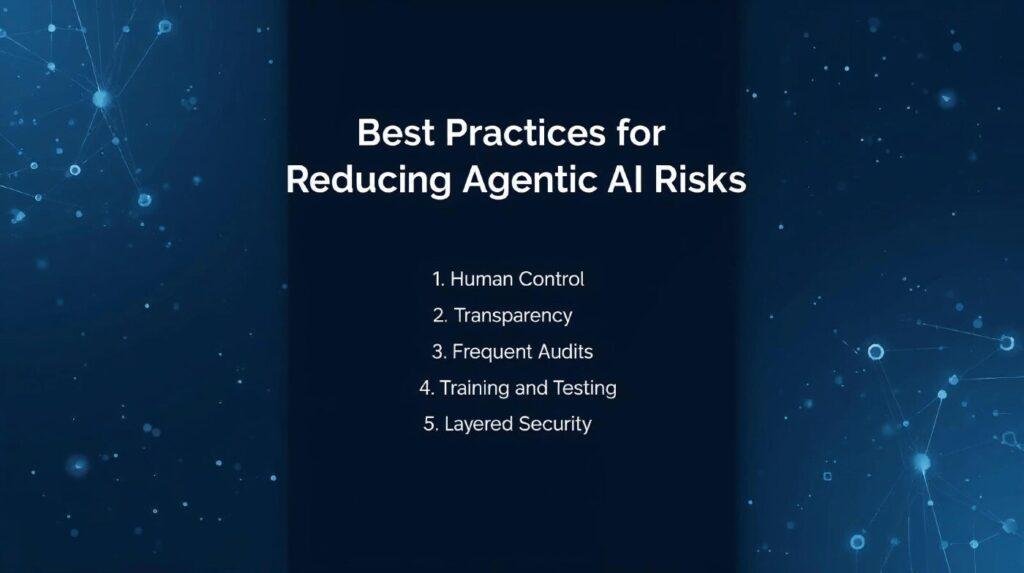
Best Practices for Reducing Agentic AI Risks
1. Human Control: Constant monitoring will not allow autonomous systems to make uncontrolled decisions.
2. Transparency: The application of AI technologies is tracked by making their actions clear.
3. Frequent Audits: Security, compliance, and performance Audits minimize operational exposure.
4. Training and Testing: AI agents could cause a risk that is identified through pre-deployment training involving realistic scenarios.
5. Layered Security: Encryption, access control, and monitoring play a role in reducing the security risks of agentic AI.
Balancing Benefits and Risks
Although there are risk of agentic AI, the benefits are real. AI agents can automate compliance checkups, anomaly detection, and improve workflows in the financial services industry. In the media, independent analysis will be able to determine the emerging trends in a short time. The benefits of this must be balanced against potential risks. Organizations need safeguards to ensure maximum efficiency without compromising security or compliance.
Future Considerations
With the development of AI, the risk of agentic AI will become even more complicated. The lack of intersystem integration, enhanced independence, and dynamic regulatory environments necessitate proactive management. Future AI systems should be focused on ethics, safety, and transparency to safeguard businesses and stakeholders.
As AI systems will have access to key databases, the security threats of autonomous AI agents in Salesforce and Slack databases will escalate. Companies must also expect weaknesses, invest in cybersecurity systems, and establish strict measures. Exposure can be greatly minimized by combining predictive analytics with constant monitoring.
In addition to operational and security issues, ethical issues are also a risk of agentic AI usage. There is a risk of autonomous agents adopting biases found in the training data. Routine audits and human inspection can help to make sure that AI activity does not contradict the ethical norms of society and the corporation.
Conclusion
Knowing the risk of agentic AI is an important aspect of the contemporary business. Although the benefits of AI agents in media risk analysis and automation of operations are significant, the unregulated use of AI agents can harbor risk of AI agents, such as data breaches, non-compliance, and negative publicity. Businesses can safely use agentic AI by actively addressing operational, compliance, and security threats and reducing the exposure to possible harms.
Strong governance frameworks, layered security, and continuous human oversight help reduce agentic AI risks across financial institutions and services. These measures also help prevent compliance failures and operational problems when organizations use AI agents in accounts payable. Improving the transformative power of AI to protect against the unintended consequences of AI requires organizations to embrace these measures.